High school Design & Technology students often have to understand the meaning of quality assurance and quality control in a product design. These are particularly important terms to understand when undertaking mass or batch production (producing items at scale), as they help ensure consistency and the creation of high quality products. This article introduces students to these terms and concludes with sample examination questions.
The difference between quality assurance and quality control
Quality Control (QC) is about identifying bugs or problems in finished products; Quality Assurance (QA) is about the processes that prevent these errors from occurring in the first place.
Quality Assurance (definition)
- QA is about the system — planning and procedures put in place before and during production to prevent defects from happening
- Think of it as proactive and preventative processes that help ensure consistency, meet customer expectations and maintain standards
- QA is processed-focused and asks, “Are we doing things right?”
- Examples: creating a production schedule with checkpoints, using standardised jigs and templates, training workers to follow specific procedures, or implementing systems to collect and analyse customer feedback.
Quality Control (definition)
- QC is about the inspection and testing you do to the product during and after the construction process to detect defects that have already occurred
- It’s reactive and detective (happens after the errors have occurred)
- QC is product-focused and asks, “Did we make it right?”
- Often influenced by rules and regulations where products have to meet specific standards (such as meeting electrical safety standards in product design)
- Examples: measuring a finished component with callipers to check it meets the specification, doing a visual inspection for surface defects, or testing a batch of products against a preset standard (may include destructive and non-destructive testing)
In practice, QA and QC work together — a good QA system reduces the amount of QC failures you get.
The goal of QA systems and QC testing is to lead to improved product design.
Tools to improve quality control
Stencils

- A thin sheet of material with a design cut out of it
- Used by drawing inside, applying paint or ink through the cut-out areas onto a surface beneath
- Design is created by the negative space
- Typically used for repetitive designs or lettering
- Example: Spray-painting a logo onto multiple t-shirts
Templates
- A guide used to mark out similar shapes repeatedly
- Can be used to trace outlines around the outside or as a physical guide for cutting
- May have both positive and negative spaces
- Example: A plastic shape used to draw consistent curves in technical drawings
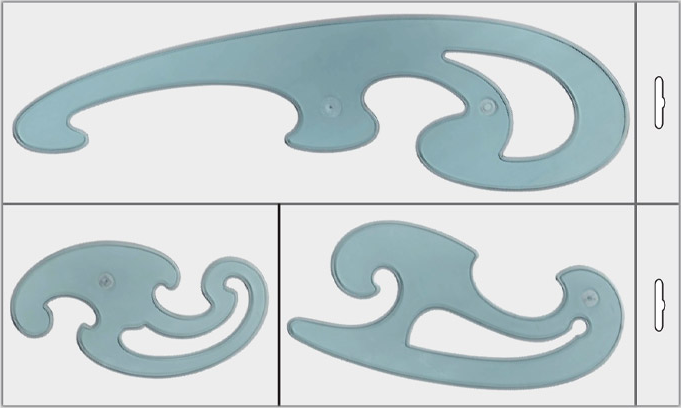
A template can be an efficient tool for creating multiple identical nets of a package by serving as a master design or pattern. If you need to cut something out a net from cardboard multiple times, you can create a template from card, MDF, or some other stiffer material and trace around it multiple times, ensuring consistency. This template could contain all fold lines, cut lines, tabs, and dimensions etc. Not good for mass production, but useful if you need to make multiple copies in small batches.
Jigs
- A tool, object or device (often custom made for a specific situation) that helps you hold or guide something as you perform a repetitive task like drilling or tapping holes, without you having to measure or guess each time (can hold the product or tool)
- Increases accuracy, speeds up production, and maintains consistency
- Useful when creating multiple copies of a product by hand or using hand-held electric tools

Formers and moulds
Various formers and moulds can be used to shape multiple items all the same, such as a former used in the vacuum forming process.
Computer aided design and manufacture (CAD/CAM)
CAD/CAM helps immensely with QA and QC, as it is able to ensure things are repeated with extreme accuracy and precision (see more about how CAM helps improve quality control here). Automated feedback in digital systems can play a key role in QA systems. Emerging technologies, such as virtual reality can also be used in the quality control processes, creating simulations to help test the effectiveness of a product etc.
How can computers can enhance stock control and quality control?
- Real-time tracking and monitoring tracking stock levels across multiple locations, helping co-ordinate across different stores in a retail chain
- Barcode scanners allow shops to automatically update stock databases as items move in and out, eliminating manual counting errors and providing accurate up-to-date information
- Automated systems can monitor when stock gets low so people know when to order new supplies (optimising storage space)
- Algorithms can help forecast when stock will be needed – analysing historical sales data and trends (helping prevent waste)
- Automated systems can help inspect production lines – improving quality control (using sensors and automated scanning etc)
- Can track data about defects and returns – helping identify weaknesses and areas These computer-enhanced systems reduce human error, increase efficiency, lower costs, and ultimately improve customer satisfaction through better product availability and consistent quality.
Standardised components
Using common pre-made standardised components is also a way to increase quality control.
The benefits of using standardised components include:
- Consistency of quality: Standardised components help ensure consistent quality across product ranges. When manufacturers use standard components, customers can rely on uniform quality regardless of when or where the product was produced. Standard components have established quality control processes and specifications. Customers benefit from components that have been thoroughly tested and proven reliable through widespread use in the industry.
- Specialisation: The manufacturer can specialise in their own particular area, rather than requiring speciality in multiple sub-areas. They may not have the equipment or expertise to make all the components. This improves accuracy, speed, confidence in product etc (also improving quality control).
- Cheaper: The use of standardised components significantly reduces manufacturing costs, due to economies of scale. Consequently standardised parts can be far more cost effective, with different size / specification components able to be purchased as required at competitive prices. Rather than obscure unique components designed by one company, standardised items can typically be purchased multiple places, leading to competition between companies, driving prices down. The use of standardised components also speeds up production times and reduces errors, resulting in faster delivery times for customers, ultimately reducing costs.
- Ease of replacing parts: Using standardised components makes replacement and maintenance more straightforward. Using standardised components also means the sizes of things are designed around industry standards, which helps enormously with replacement parts. Replacing parts is also better for the environment as items can be fixed and used rather than discarded.
- Consistency across suppliers and regions: Standardised components ensure products work across different markets and regions, benefiting customers who operate globally.
- Simplified manufacturing process: Standardisation allows for more efficient inventory control and storage, as well as fewer steps in the production process. When pre-made components are used, there is often a reduced learning curve, as customers become familiar with standard components across different products, so staff require less training.
- Supply chain reliability: Standard components are typically more readily available from multiple suppliers. This means customers face fewer delays and supply issues when they need replacements or additional components. As stock is expensive to store, parts can often be ordered and supplied very rapidly – “just in time” (JIT) manufacturing, providing greater flexibility.
Total Quality Management (A2 students only)
[Coming soon]
- The benefits of introducing Total Quality Management (TQM) to a production process. (Total Quality Management involves applying quality assurance procedures at every stage of the production process.)
- The benefits of quality systems to the manufacturer and the consumer. – A2]
Sample examination questions (AS Design & Technology)
[Coming soon]

Amiria has a Bachelor of Architectural Studies, Bachelor of Architecture (First Class Honours) and a Graduate Diploma of Teaching. She is a CIE Accredited Art & Design and Design & Technology Coursework Assessor. Amiria now teaches Art, Design & Technology at ACG Parnell College.