This article summarises different ways to join card and other lightweight materials, using temporary joints, permanent joints, pop-up features, and rotating mechanisms. It concludes with examination questions to help you revise this material.
Permanent joints cannot be undone without damaging the material (these joining methods are not intended be taken apart afterwards).
PERMANENT LIGHTWEIGHT JOINTS
Glue tabs
Properties
Uses
You must mention an appropriate glue for the material. See different adhesives here.
Double-sided tape
Properties
Uses
Staples
Properties
Uses
Snap rivets
Properties
Uses
Glue dots
Properties
Uses
Zip-ties
Properties
Uses
Stitching
Properties
Uses
Note: When manufactured, different card elements and other materials can also be permanently laminated together using adhesive, heat sealing or wet bonding (pressed together while being made)
Temporary joints can be undone without damaging the material (are designed to be easily taken apart). This helps with disassembly and re-use of parts.
TEMPORARY LIGHTWEIGHT JOINING METHODS
Tabs & slots
Properties
Uses
Make sure closing tabs cannot be easily pulled undone
Velcro
Properties
Uses
Brass paper fasteners
Properties
Uses
Magnets
Properties
Uses
Rubber bands
Properties
Uses
Ribbons
Properties
Uses
String with eyelets
Properties
Uses
Photo corner stickers
Properties
Uses
Clips
Properties
Uses
These are not commonly used in graphic products, but may be useful when something needs to be moved or re-clipped by the user
Nylon bolts
Properties
Uses
A low-tac adhesive, such as repositionable spray adhesive can be used for temporary connections also.
ROTATING OR MOVING PARTS
Opening ‘mouth’
Properties
Uses
Slide-across tabs
Properties
Uses
Pop-up portions
Properties
Uses
Rotating disc
Properties
Uses
Other methods include a thumb tack embedded in stiff card
Sample examination questions (AS Design & Technology)


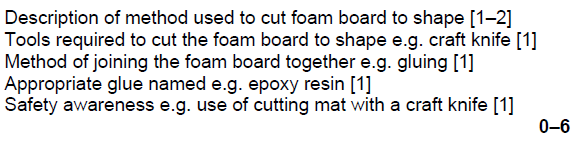
Examiner comment: This question was well answered, with good understanding of how the foam board could be cut out and joined. Tools, equipment, and processes were generally well covered as were safety precautions.


Examiner comment: Candidates generally had a thorough understanding of how to join the card closure to the plastic bag with various low-tac adhesives given. The ability to be opened and closed was not always answered. Candidates should ensure that they always check they have answered all aspects of a question.





Examiner comment: Many very creative responses were seen to this question. Most candidates were able to show a temporary method of attaching the corrugated card poster to the PVC frame. The most common answers included the use of slots, clips, push fittings, magnets, Velcro and plastic screw fasteners. The quality of sketches and notes was usually of a high standard and sufficient to communicate the joining method. A small number of candidates incorrectly showed a permanent method of attaching the corrugated card poster to the PVC frame.


Examiner comment: Most candidates were able to correctly explain how the foamboard discs could be secured and made able to rotate.

Amiria has a Bachelor of Architectural Studies, Bachelor of Architecture (First Class Honours) and a Graduate Diploma of Teaching. She is a CIE Accredited Art & Design and Design & Technology Coursework Assessor. Amiria now teaches Art, Design & Technology at ACG Parnell College.