Design & Technology students often evaluate products in terms of environmental impact and sustainability. The Cambridge syllabus explains that designers have a responsibility to ensure that products and packaging are made from sustainable materials and components. The aim of this analysis is to help identify ways that designers can minimise negative environmental impacts and reduce non-renewable resource consumption throughout a product’s lifecycle.
Note: It can also be helpful to analyse the impact of the environment on the product – considering site-specific factors, such as sun exposure, wind patterns, temperature fluctuations, noise levels, and so on.
What does sustainability mean?
Sustainability means living in ways that don’t harm the environment or exhaust natural resources, so that both current and future generations have the resources needed to live healthy lives.
SUSTAINABILITY: The use of resources and energy in a way that meets the needs of the present generation without compromising the ability of future generations to meet their own needs.
– 0445 Design & Technology Syllabus, 2028-2030, Cambridge International Examinations
What are the 6Rs of sustainable design?
The 6Rs are principles of sustainable design and consumption: Reduce, Reuse, Recycle, Refuse, Rethink, and Repair. These principles provide a framework for minimising environmental impact and creating more sustainable products, services, and behaviours from initial design through to end-of-life.
- Reduce: Minimizing consumption and waste by buying and using less. This includes choosing products with minimal packaging, buying only what you need, and being mindful of resource usage like water and electricity.
- Reuse: Extending the life of items by using them multiple times or finding new purposes for them. Examples include using reusable shopping bags, water bottles, and containers, or repurposing glass jars for storage.
- Recycle: Converting waste materials into new products by processing them – ensuring that fewer raw materials are used. This involves properly sorting recyclable materials like paper, plastic, glass, and metal, and ensuring they enter the appropriate recycling streams.
- Refuse: Declining items that you don’t need, particularly single-use items and excessive packaging. This might mean saying no to plastic bags, promotional items, or unnecessary purchases.
- Rethink: Reconsidering consumption habits and finding more sustainable alternatives. This involves questioning whether purchases are necessary and exploring more environmentally friendly options.
- Repair: Fixing items instead of replacing them, which extends their lifespan and reduces waste. This can include mending clothes, repairing appliances, or maintaining items to prevent damage.
Which materials can be recycled many times without losing quality?
Some materials can be recycled almost infinitely with minimal loss of quality.
- Glass can be recycled endlessly without any degradation in quality or purity. When cleaned, crushed, and melted, it maintains its properties and can be reformed into new glass products repeatedly. Crushed glass can also be used as an aggregate in the construction industry (i.e. in concrete mixes etc)
- Aluminium, steel, copper, brass, gold and other metals can be recycled over and over without losing their strength or quality. The recycling process involves melting and reforming the metal without degrading its fundamental properties.
The environmental impact of plastic
- Plastic degrades very slowly
- Burning can release toxic fumes
- Thermoplastics (plastics that soften when heated) can be remelted and used, however the plastic generally degrades in quality with each recycling cycle and can only be recycled a limited number of times before becoming unusable
- Thermoset plastics (those that won’t remelt / reform) can sometimes be ground up and used as a filler in other composite products, such as concrete, asphalt, or other building materials
- Recycling plastic is difficult because:
- It is challenging to make an automated system that can sort plastic into the different types, so it is labour intensive
- Plastic items (i.e. cell phones) often have many small parts, made from different types of plastic) and the cost of separating the parts often outweighs the recycling value
- Some plastics are unprofitable to recycle (i.e. polystyrene)
Learn more about different types of plastic here.
Recycling paper and cardboard
- Paper fibres can typically only be recycled 5-7 times before becoming too short and weak to be used again (recycling causes paper fibres to break down, so each time the quality degrades)
- Used paper is pulped and often combined with pulp from new wood to strengthen it
- Recycled paper intended for printing grade or other white paper must be de-inked, so not contaminated by dye
- Other recycled paper is used for boxes and coarse papers
- Papers that are coated with plastic, aluminium foil, wax or paste cannot be recycled because the process is too expensive
- Glossy inserts are sometimes not recyclable
- Gift-wrap cannot be recycled because it is already low quality
Learn more about different types of paper and cardboard here.
Recycling Batteries
- Batteries are difficult to recycle – they contain toxic heavy metals (including lead, mercury, cadmium, nickel) which can harm the environment if not properly disposed of, making recycling vital
- Different battery types (lithium-ion, nickel-cadmium, lead-acid, alkaline, etc) require different recycling processes and careful sorting, which complicates recycling systems
- Rechargeable batteries reduce waste by replacing multiple single-use batteries, but still require recycling at end-of-life to prevent toxic materials entering landfills

Problems with recycling
- Sometimes not cost effective – cheaper to just use ‘virgin’ products
- Often not economically viable, i.e. cardboard packaging for food products is more easily recycled than plastic, but is heavier to ship and may result more waste from spoilage
- Recycled products sometimes not appropriate, particularly for packaging of food, toiletries and cosmetics (if these come into direct contact with the card they can become tainted / contaminated). Solutions:
- Card could be given a plastic or foil coating
- Secondary packaging could be used (i.e. a plastic bag inside a card cereal box)
- Many products not designed with recycling in mind
- Many items are discarded in a dirty state and contaminated by residue from the original contents
- Recycling plants typically require a lot of space
- Manual sorting of rubbish can be messy and labour intensive
Product labelling helps to indicate which products can be recycled, and which products contain recycled material (see recycling symbols).
Closed-loop systems
Closed-Loop Systems are systems where materials can be continuously recycled or reused, though this is often an ideal rather than a fully achievable reality.
For example, on a sustainable farm the manure from the animals helps to fertilise the soil, which helps to grow the animals…so the waste from one part of the system is used by another part of the system.
Energy use in product design
Products can use many forms of energy including:
- Electrical – lighting systems, electrical motors, solar panels)
- Kinetic (energy generated from movement) – wind turbines, water wheels, pendulum clocks, pedals, hand cranks and other simple mechanism)
- Potential (stored energy) – coiled springs, compressed air, elevated water, stretched elastic bands
- Thermal (heat) – wood-burning stoves, heat pipes, thermal mass materials such as concrete and stone that absorb heat from the sun during the day and release it at night
- Chemical (energy released during chemical reactions) – batteries, biofuels derived from plant materials, photosensitive materials that change properties with light exposure

Mechanisms or devices that convert one form of energy to another
- Motors convert electrical energy into kinetic energy that can carry out some function (electric motors in appliances, fans, electric vehicles, power tools)
- Engines typically convert thermal or chemical energy into through combustion (i.e. combustion engines in cars, diesel engines, jet engines, steam engines)
- Machines transmit or modify force or motion to perform work. Machines typically have multiple components working together to transform energy from one form to another or to change the direction, magnitude, or point of application of a force. For example, a wind turbine has multiple components which transforms energy from one form to another (converting wind’s kinetic energy into mechanical rotation and then into electrical energy)
Energy sources
Designers should be aware that some energy sources are finite (run out) and others are renewable and should aim to make design choices that conserve energy.
- Renewable energy sources: solar, wind, water etc.
- Finite energy sources: fossil fuels (such as oil, natural gas, coal), nuclear energy (primarily uses uranium as fuel, which exists in finite quantities in the Earth’s crust)
Many governments around the world are prioritising the use of renewable energy sources.
Thanks to windy coastlines and shallow seabed, the UK has led the development of offshore wind. World-leading research and testing capabilities has enabled us to develop several of the world’s largest offshore wind farms, as well as floating turbine technology which allows wind farms to be developed in deeper waters.
– Energy UK, Electricity Generation (2023)
Electricity Generation
Creating electricity requires a magnet moving within, beside, or around a coil of wire – so the magnetic field passing through the coil changes and electricity is generated. The magnet and coil together are known as a generator.
The magnet often spins/rotates inside the coil (most common), but sometimes oscillates or moves in a linear motion.
An energy source creates movement, which then turns the generator (in other words, moves the magnets alongside the coils of wire).
- Hydroelectric dam: falling water hits blades and makes turbine spin → turbine spins a shaft → spins generator (rotating magnets inside coil)
- Coal/gas/nuclear power plant: heat boils water into steam → rising steam makes turbine spin → turbine spins a shaft → spins generator (rotating magnets inside coil)
- Wind turbine: moving air makes turbine spin → turbine spins a shaft → spins generator (rotating magnets inside coil)
This movement creates electricity (movement of electrons) inside the wire coil, which, if a circuit is plugged into it, then causes an electric current to flow out and power other connected devices.
The energy source (wind, water, steam) is just the method of spinning. Regardless of the energy source used, the method of electricity generation is the same: spinning magnets near coils creates electric current.
A dynamo bike light system uses a hub-based or tire-driven generator to power lights while pedaling, eliminating the need for battery charging.
A wind-up radio (or crank radio) is a portable radio powered by a hand-cranked generator and a rechargeable battery, requiring no external electricity or replaceable batteries. Primarily used for emergencies, camping, or power outages, it converts mechanical energy from turning a handle into electrical energy to play a radio and often features flashlights or phone charging cabability.
Life-cycle Assessment
Many companies carry out a life-cycle assessment (LCA) looking at how energy use across the life of a product. This is a big-picture analysis considering energy consumption, raw material extraction, carbon emissions, and pollution across the whole product lifecycle, with the aim of minimising environmental impact. This can involve attributing a percentage to each stage of the lifecycle, so that it is clear which life-cycle stages have the greatest impact on the environment.

Designing for ‘mechanical advantage’
Mechanical advantage is the idea that a machine can multiply a force to make a task easier. For example, you may have ridden a bike where adjusting the gears makes it easier to bike up a hill. Or you may have used a tommy bar (see below) or a lever to help turn something. These kind of designs mean that less force is applied applied over a greater distance, so the task feels easier.
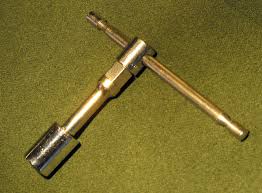
A tommy bar is a simple metal bar or rod that’s inserted through a hole in a tool to provide leverage for turning it. It acts as a handle to apply torque (a twisting or turning force that creates rotary motion). The longer the handle is, and the greater the distance from the pivot point, and the easier it is to turn.
A pulley is a simple machine consisting of a string (or rope) wrapped around a wheel (sometimes with a groove) with one end of the string attached to an object and the other end attached to a person or a motor. Pulleys may seem simple, but they can provide a powerful mechanical advantage so lifting tasks may be done easily.
The real mechanical advantage of a pulley is in using many pulleys at once. Using multiple pulleys decreases the amount of force necessary to move an object by increasing the amount of rope used to raise the object. The mechanical advantage (MA) of a pulley system is equal to the number of ropes supporting the movable load.
Powerful Pulleys, www.teachengineering.org
Ratchet mechanism

Hydraulic systems
A hydraulic system uses a fluid enclosed in a sealed system of tubes and hydraulic cylinders (also known as hydraulic rams) to transmit force from one point to another. When fluid (usually oil but sometimes water) is pushed into one end of the system by a hydraulic pump (typically driven by an engine or electric motor), it transfers that pressure through the liquid in the tubing to the other end (the output), which moves in response.
In real hydraulic systems (like those in diggers, excavators, or car brakes, or hydraulic presses), oil is pushed into a hydraulic ram, which is a metal cylinder with a piston inside. The fluid pushes the piston, which extends or retracts a rod — and that rod is what moves the arm, bucket, or whatever component it’s attached to.
Fluids are used in hydraulic systems because they are:
- Liquids like water and oil can withstand compression (meaning you can’t squish them into a smaller space) so when a force is applied, the force is transmitted almost instantly through the system.
- The tubing can bend around corners (this means the input force can be applied in one direction and the output can move in a completely different direction). Fluids conform to the shape of their container, meaning they can flow through narrow, flexible tubing and around complex paths, making the system adaptable and compact.
- Different size diameters can be used to create mechanical advantage (i.e. oil that is squeeze through a smaller hole must travel faster – you can test this by squirting water through a hose). By using cylinders of different diameters, the system can amplify force.
- Oil is normally used as it oil lubricates the system and prevents rust.
- Leaks can easily be topped up.
How to evaluate environmental impact and sustainability
The following list of questions guides students through evaluating a product in terms of environmental impact and sustainability.
Site, location, and surrounding environment
- Where is the product currently located? Is this a typical location for the product? Is it permanently positioned in one location, or can it be moved? Is it constantly moving?
- What impact does the product have on the environment?
- What impact does the environment have on the product? (Consider sunshine angles, shadows, overheating, cool and damp areas, noise from neighbouring environments, and so on.)
- Is energy from the environment harvested or utilised in running or using the product (i.e. thermal mass in buildings, or solar powered contraptions). Are there any nearby, readily available materials or energy sources that could be utilised within the product?
- Can the product be adjusted or adapt to changes in the external environment? (Such as by opening windows, erecting sunshades, or opening ventilation panels, raising flood barriers, activating heating/cooling systems, or implementing seasonal modifications).
Conservation of Resources / Minimising waste
- Are the materials renewable (such as sustainably harvested timber, bamboo or cork – which come from trees/plants that can be regrown – or natural fibres such as cotton or wool)? What advantage does this have? (Consider not the advantage of helping the environment, but in being able to promote a sustainable image to potential customers.)
- Could existing materials be substituted for more eco-friendly alternatives – including recycled materials, reducing the use of fresh raw materials? Would this affect the cost or function of the product?
- Can the volume of material used be reduced, such as by reducing packaging, or designing nets/developments to fit neatly into sheets of materials?
Energy use
- What type of energy forms are used during different stages of the product life cycle (production, use, maintenance, and disposal)?
- Does it use renewable energy sources?
- Does the product convert one form of energy to another?
- How might this use of energy be made more efficient or environmentally friendly?
- Could the manufacturing processes be modified to reduce environmental impact? Could the product be designed to require fewer production steps or simpler manufacturing techniques?
- Can the energy used during shipping be reduced by using local materials, or by improving stackability so the product takes up less space in shipping containers?
When designing a product designers should consider the use of energy at all stages of the product lifecycle (during production, use, and at the end of the life cycle). - Can the manufacturing process be reduced or made more efficient so that less energy is used?
Biodegradability
- Are materials easily degradable or recyclable? Can they decompose safely without harming the environment? Is there room for improvement in these areas? Can offcuts or byproducts be utilised or disposed of in an environmentally friendly way?
Recycling
- Does the product involve raw material extraction, or recycled materials?
- Does the product contain any recycling symbols? What do these mean?
- Is the product easily disassembled into parts for recycling and reuse? Is there room for improvement in this area? Have you tried to disassemble the product?
- Are any materials laminated or joined to others in such a way that they cannot be separated for recycling?
- Could the product be altered so as to encourage a closed-loop system?
Pollution and toxins
- Does the product useful harmful inks, solvents, or other chemical treatments, toxins, or surface finishes that might pollute the environment?
Longevity
- How long does the product typically last?
- Can the product be easily repaired? Are such products usually repaired or replaced? Does it require experts to do so? Is it possible to easily source replacement parts?
- Could the product be designed to be modular, allowing components to be upgraded rather than replacing the entire product?
- Is there opportunity to make the product last longer, or would a longer lifespan not be suitable?
- Is your product designed with built in obsolescence?
- Is the design future-proof? How adaptable is the product to future technological or lifestyle changes?
- Does the product anticipate future environmental regulations or standards?
User behavior and education
- Does the product encourage sustainable user behavior through its design? How intuitive is the product’s sustainable use? Do users need special knowledge to use it in an environmentally responsible way?
- Does the company currently promote sustainability as a strength of the product?
Ways to improve the sustainability of a product
The 2025 – 2027 Cambridge AS Design & Technology syllabus lists the following ways to make designs more sustainable:
- reducing the quantity of materials used
- reducing the number of manufacturing processes
- designing products that can be easily repaired
- using standardised components
- making products easy to disassemble or separate
- reusing components and parts
- using eco-friendly alternative materials
- using recycled materials
- using locally available materials
- reducing the need for transport costs
- finding alternative manufacturing processes
- reducing the amount of waste products produced during manufacturing
- reducing the amount of energy required in manufacturing processes
- improving the efficiency of manufacturing processes
- labelling of materials to aid separation for recycling
IGCSE (From 2028) includes:
- identify and sketch simple examples of first-, second- and third-class levers, and associated linkages
- show knowledge of gears, pulleys and belts, sprockets, and chain drives for practical applications
- recognise the need to reduce friction between two surfaces by design, and describe the types of lubrication
Sample examination questions (AS Design & Technology)


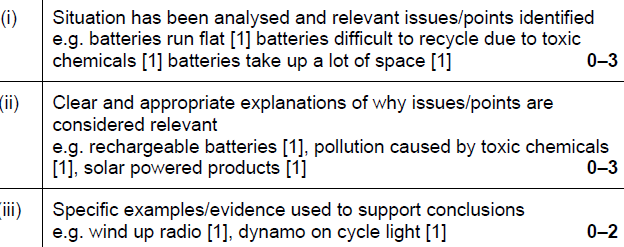
Examiner report: Most candidates had a basic understanding of why some electric powered products use energy sources other than batteries but for the most part candidates found this question challenging and did not extend their answers or give many examples.



Examiner comment: This question was generally well attempted with either linear or rotary correctly given.


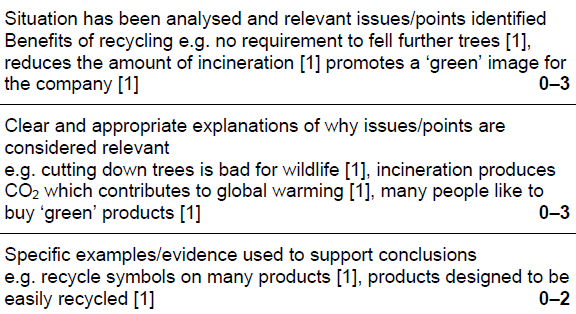
Examiner comment: Candidates who discussed such issues as recycling card being environmentally friendly, less trees needing to be cut down, a possible marketing strategy and an aesthetic opportunity did score reasonably well. Examples were not always given.



Examiner comment: Candidates were able to demonstrate an understanding of feature X.


Examiner comment: Most candidates were able to correctly state or label the tension on the string.


Examiner comment: There were some well described designs for locking the mechanism used to raise Part C in the raised position.


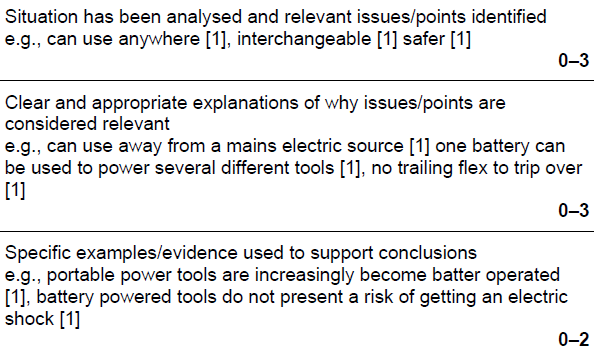


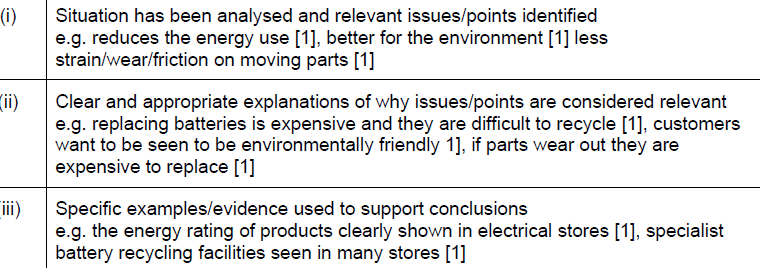
Examiner comment: Candidates often had a good understanding of why designers of products seek to make them energy efficient and communicated the benefits to the manufacturer and consumer. Some candidates did not extend their answers or give many examples.


Examiner comment: Candidates gave a very wide range of different explanations of the action of the auger and many found the question challenging.
Candidates found it challenging to explain how the length of the crank impacts upon the user. Mechanical advantage was rarely given in responses.


Candidates found it very challenging to explain how the model of the wind turbine would generate an electric current. Some candidates understood the use of rotary motion being utilised from the rotor blades.


Sample answer:
A compound pulley system uses multiple pulley wheels connected by a rope or cable that shares the load between them. This means the input force (turning the crank handle) can be less than lifting the weight directly.
Having more than one pulley multiplies the mechanical load, because it is shared between more sections of rope.
The trade-off is that the user must pull the rope through a greater distance (turn the crank handle longer) to raise the load by a given height.
(Note: answer must be accompanied by sketches to gain full marks.)
Examiner comment: Candidates found it challenging to explain how the compound pulley system makes it easier to lift loads. Mechanical advantage was rarely given in answers.

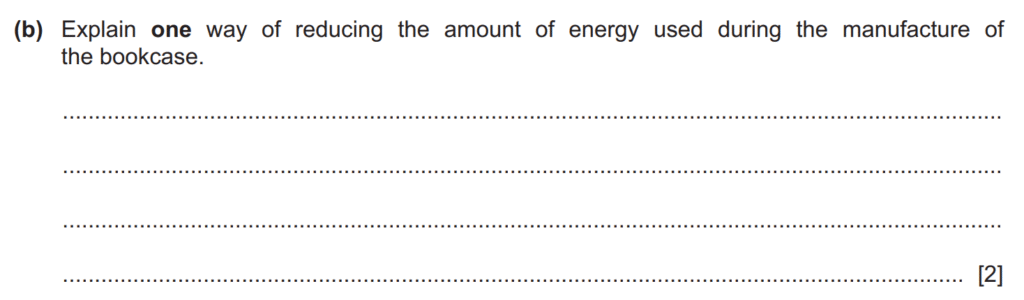

Examiner comment: Most candidates were able to explain one way of reducing the amount of energy used during the manufacture of the bookcase. Some candidates answered this question from the perspective of a one-off production and others from quantity production. Many candidates referred to making the bookcase using hand production techniques rather than machines powered by electricity, purchasing the materials in the correct sizes so that less machining was needed, purchasing materials locally so less energy was used in transportation, the use of low energy lighting or machines in the workshop and making sure the workshop was well insulated so that less energy was used to heat it. A small number of candidates incorrectly referred to using alternative sources of energy, such as solar power, that would not reduce the amount of energy used.


Examiner comment: Candidates were asked to use sketches and notes to show how sustainability had been considered in the design of takeaway coffee cup. Many excellent responses were seen to this question, with the quality of sketches and notes usually of a very high standard. The most common responses referred to card and corrugated card which could be recycled after use, the fact that card is biodegradable so it would not need to go into landfill or be incinerated, and that the polymer lid could easily be separated from cup and sleeve for recycling.

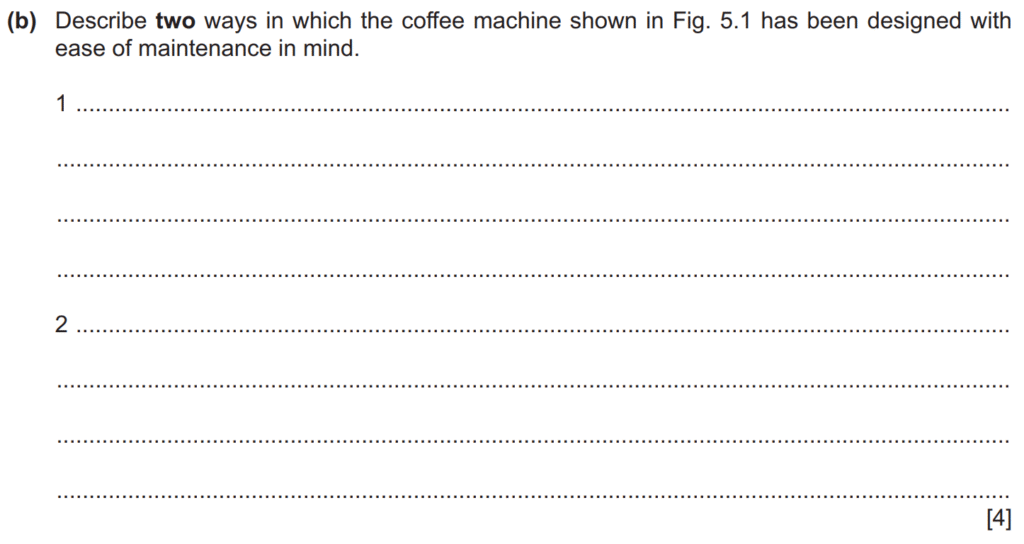

Examiner comment: Candidates were asked to describe two ways in which the coffee machine has been designed with ease of maintenance in mind. Answers included that the parts of the coffee machine are made of materials such as stainless steel and smooth plastic that can easily be wiped clean, that the machine can easily be opened for a mechanic to remove and replace broken parts and that the machine uses standardised components, such as the digital display that are readily available and can be quickly replaced if faulty.


Examiner comment: Candidates found it very challenging to describe motion conversion in the toolmakers clamp.

Examiner comment: Some candidates understood the use of mechanical advantage, with the use of a tommy bar or a similar principle being the most popular answers.


Examiner comment: Candidates found it very challenging to describe reciprocating, liner and rotary motion in the pulley system.

Examiner comment: Some candidates understood the use of mechanical advantage but generally this proved a challenging question.
Discuss why designers of packages should consider environmental issues.


Note: This question content covers content that is not mentioned in the new, updated syllabus, however this question has been included here just in case!


Sample answer:
Tool A — slip joint pliers
The two halves of the tool act as levers, connected by a variable pivot that can be repositioned into different grooves. When the handles are opened wide, the pivot bolt can slide out of one groove and into another, changing the jaw opening width. The grooves provide a series of stepped jar width positions, allowing the pliers to grip objects of different widths. When force is applied to the handles, the lever action multiplies grip force at the jaws (mechanical advantage), and the pressure locks the pivot into its selected groove, preventing it from slipping during use.
Tool B — adjustable spanner
The adjustment mechanism uses a worm gear (screw thread). One jaw is fixed as part of the main body, while the other jaw (the movable jaw) slides along a track or channel in the head of the spanner. The small thumbwheel (worm screw) meshes with a rack of teeth or channels cut into the back of the movable jaw. When the thumbwheel is rotated, the worm screw drives the movable jaw along the channel, either opening or closing the gap between the jaws. This converts rotary motion into linear motion and allows continuous, fine adjustment to fit different sized nuts and bolts. The worm gear is self-locking, so the jaw holds its position under load.
Examiner comment: Candidates found it very challenging to use notes and sketches to describe the mechanisms.
Note: This question covers content that is not covered in the new updated AS Design & Technology syllabus, but has been included here just in case!


Examiner comment: Generally, this was answered well. Tubes which could be curved when carrying fluids was a popular response.
Note: This question covers content that is not covered in the new updated AS Design & Technology syllabus, but has been included here just in case!


Examiner comment: There were some well described designs for moving the digger arm up and down. Unfortunately, some candidates did not fully explain how the digger arm could be moved by using syringes and plastic tubing.
Sample description:
You need two syringes connected by a length of plastic tubing. The whole system is filled with water (no air bubbles) and sealed.
Syringe 1 (the input/control syringe) is held by the user, away from the model. This is the one you push and pull by hand.
Syringe 2 (the output syringe) is mounted onto the model itself. The barrel of this syringe is fixed to the frame (the upright part near pivot joint A), and the plunger end is attached to the arm — specifically to the underside of the arm, behind the pivot point.
To raise the arm you push the plunger on syringe 1. This forces water through the tubing into syringe 2, extending its plunger outward. Because the plunger of syringe 2 is attached to the arm and pushes against it, the arm pivots upward around joint A.
To lower the arm you pull the plunger on syringe 1 back. This draws water back from syringe 2, retracting its plunger. The arm pivots back down — helped by gravity and the weight of the bucket.

Amiria has a Bachelor of Architectural Studies, Bachelor of Architecture (First Class Honours) and a Graduate Diploma of Teaching. She is a CIE Accredited Art & Design and Design & Technology Coursework Assessor. Amiria now teaches Art, Design & Technology at ACG Parnell College.