To become an effective designer, you must understand how scale of production (individual, small batch, and mass production) impacts the manufacturing process. Understanding these systems of production, as well becoming familiar with terms such continuous production and just-in-time manufacturing, helps designers make better design decisions.
Individual production (one-off items)
- Often involves a high level of craftsmanship, with high quality products;
- Often has motivated staff, because they have direct control over the creation of original products, with interesting and varied tasks;
- Products can be individually made to customer requirements;
- Products are unique and hence often considered more desirable;
- High cost per unit (takes lots of time to make each item);
- Skilled workers needed
- Not suitable for making many products that are exactly the same (hard to keep items perfectly consistent);
- Easier to manage – control of production sequence is often simple, because whole operation is small.
Batch production
This involves small batches of a product being made at once.
- More flexible than mass production;
- Can adjust to changes in product demand relatively easily (after each batch is complete, the process can be adapted as needed);
- Less expensive machinery than mass production;
- Faster than individual production, but slower than mass production;
- Needs careful budgeting – can involve bulk purchasing materials at the start – larger initial cost, but saves money overall (often discounts for purchasing larger volumes). Having all materials on-hand avoids production delays and helps ensure consistency, as quality control checks of materials can be undertaken at the start.
- Requires significant storage space and careful inventory management, which can create challenges.
- Changes between batches can be small (i.e. just a colour change).
- Can be complicated switching between batches – time-consuming changeovers, including cleaning, resetting, and recalibrating equipment, reducing overall production efficiency.
- Inspections, testing procedures, and other quality control measures can help ensure consistency between batches;
- The use of jigs and templates can help improve consistency.
Jig: a custom-made tool or device to guide the motion of another tool or hold a workpiece in a specific position while making it. Jigs help to ensure consistency when repeating a processes multiple times. For example, a drill jig might be used for precise placement, or to help hold timber while bending around a mould.
Mass Production
This involves the production of standardised items through a largely automated system.
- Separates each part of the manufacturing process – division of labour – using conveyor belts, machines and workers on production lines etc;
- Big cost to set up (purchase of all machines etc);
- Much cheaper long term due to economies of scale (faster to produce / low overheads per unit / low labour costs / better prices due to bulk purchasing of materials). This results in more affordable products and drives increased profit for manufacturers.
- Often involves manufacturing a very narrow type of product, as costly to suddenly start manufacturing something different;
- Quality control is easier because all units are likely to be very similar – much easier to have standardised systems with everything exactly the same;
- Harder to manage the whole operation and establish where errors are going on, because operation so large;
- Products may be ‘cheap and nasty’;
- Tasks are often repetitive, boring, and simple, leading to unmotivated staff and reduced job satisfaction
- Can be increased injury risk due to boredom / repetitive tasks / rapid pace of mass production. On the other hand, mass production methods can also improve workplace safety by removing workers from dangerous processes through the use of automated systems.
- Staff can become specialised / expert at their one task, leading to increased efficiency.
- Mass production methods can lead to loss of jobs as automation replaces human workers. However, mass production can create new types of skilled positions in areas such as machine maintenance, quality control, and production planning.
- Shift work and long hours: Continuous production can impact workers’ work-life balance and social relationships. Many mass production facilities operate 24/7, requiring workers to adapt to changing shift patterns.
Continuous Production is a type of mass production that never stops – it runs 24/7, and is often used when stopping the plant is costly.
Just-in-time manufacturing
Just-in-Time (JIT) is a production strategy where materials are delivered and products are made only as needed, reducing inventory costs and waste. Parts arrive “just in time” for use in production, rather than being stored in large quantities.
Amazon ‘print-on-demand’ facilities are an example of just-in-time manufacturing. When a customer orders a copy of self-published book via Amazon, for example, the book is printed right at that moment and shipped out to customers. There are no warehouses holding copies of these books. They are only printed as an when they are needed.
Note: Products can use more than one manufacturing process, i.e. have some parts mass produced and some parts batch produced.
Why do manufacturers consider the total number to be made before deciding the method of production to be used?
- Production volume affects material purchasing decisions and costs. This consideration is important because bulk material purchases often offer better rates but require higher initial investment.
- The total quantity produced affects storage requirements and associated costs.
- The number needed determines which production method will be most cost-effective. Different production methods have vastly different setup costs and per-unit costs. High setup costs must be spread across the total number of items produced.
- The production method directly impacts delivery schedules. Hand-cutting small quantities of a card product might be feasible, but for larger quantities, die-cutting becomes more time-efficient. Jigs and templates can speed up production if multiple copies are needed.
- Quality considerations: Production quantity influences the ability to maintain consistent quality across the batch. While hand-finishing might ensure high quality for small runs, automated processes become more reliable for maintaining consistency in large quantities.
Note: the content below is for A2 students only.
Concurrent Engineering
This is an approach where different stages of product development happen simultaneously rather than sequentially. Teams working on design, manufacturing, and other aspects collaborate from the start, reducing time to market and catching potential issues early.
Computer-Integrated Manufacturing (CIM)
This refers to the use of computer systems to control the entire production process, from design and engineering to manufacturing and quality control. Computer-Integrated Engineering (CIE) specifically focuses on using computer systems to integrate various engineering activities like design, analysis, and simulation.
Cell Production
This involves organising manufacturing into work cells – small, self-contained units where a team completes a whole product or major component. Each cell contains all necessary equipment and workers, improving efficiency and reducing material movement.
In-line Assembly
This method arranges production in a linear sequence where products move continuously from one workstation to the next, with each station performing specific tasks in order. This is common in automotive and electronics manufacturing.
Sample examination questions (AS Design & Technology)


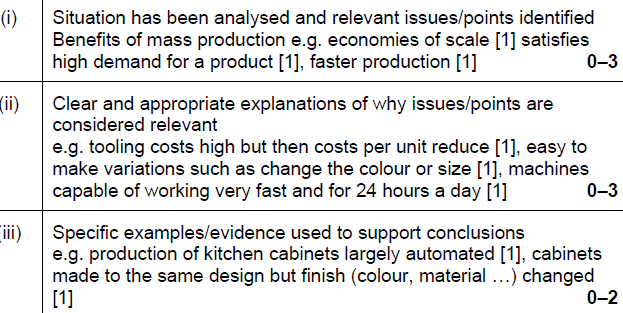
Examiner comment: Candidates gave a broad range of answers; those who understood why the chair was designed to be mass produced gave some detailed responses. Where examples/evidence were used they were generally well linked within the question.

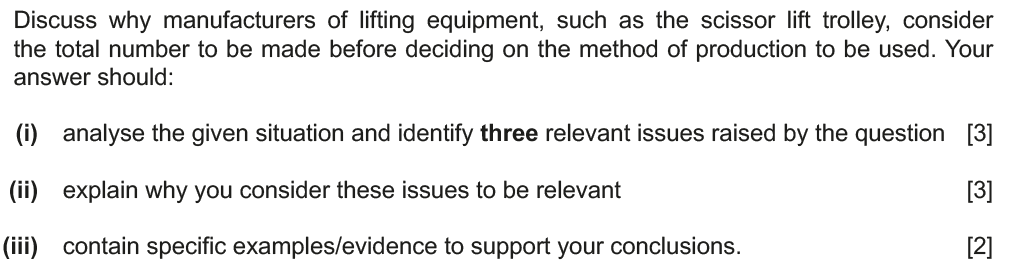

Examiner comment: Candidates had some understanding of the need to know the number of scissor lift trolleys to be made before deciding on the method of production. However, many candidates found this question challenging and did not extend their answers or give many examples.


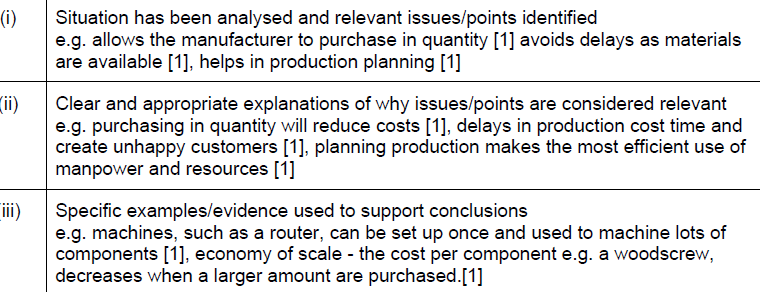
Examiner comment: Candidates gave a broad range of answers relating to the purchase of all resources before production begins. Explanations were often thorough but examples were not always given.


Examiner comment: Candidates often had a good understanding of the impact of mass-production on the people involved. Positive and negative impacts were communicated with a wide range of people considered. Some candidates found this question challenging and did not extend their answers or give many examples.
Discuss why packaging can be produced in one factory and the product inserted into the packaging in another factory.


Examiner comment: Candidates often found it challenging to explain why packaging is produced in one factory and then the product inserted into the packaging in another factory. Candidates who discussed issues such as designing and printed packaging being a specialist process, that packaging can be transported flat packed and the need for food hygiene and avoiding contamination answered well. Examples were not always given.

Amiria has a Bachelor of Architectural Studies, Bachelor of Architecture (First Class Honours) and a Graduate Diploma of Teaching. She is a CIE Accredited Art & Design and Design & Technology Coursework Assessor. Amiria now teaches Art, Design & Technology at ACG Parnell College.