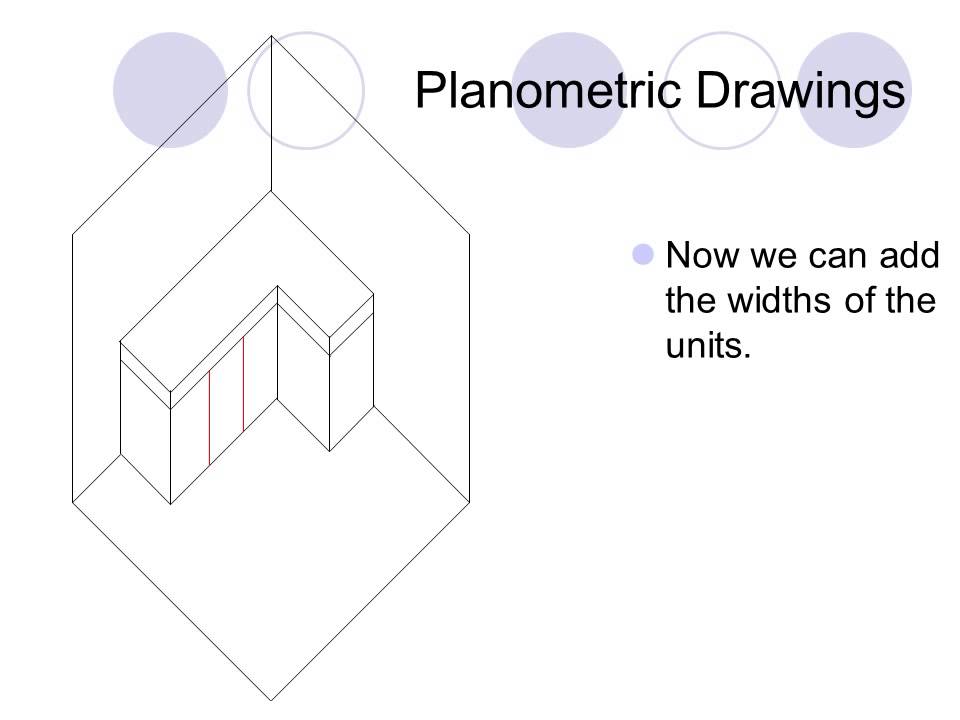
Planometric is a pictorial (3D) drawing method where the base and plan view (view from above) are tilted over at 45° × 45° (or sometimes 60° × 30°), with the sides projected vertically downwards/upwards. The base and the top of the object retain their true shape.

- Very fast and easy method
- Circles on the top and bottom faces just appear as normal circles (circles or arcs on the side can be plotted as points) making it much simpler than isometric
- Useful for showing floor plans in architectural drawings
- Not a very realistic drawing method – objects tend to look distorted / elongated


Amiria has a Bachelor of Architectural Studies, Bachelor of Architecture (First Class Honours) and a Graduate Diploma of Teaching. She is a CIE Accredited Art & Design and Design & Technology Coursework Assessor. Amiria now teaches Art, Design & Technology at ACG Parnell College.